
Management Advisory ReImagined
About Oak Cliff
The world changed. The consulting model did not.
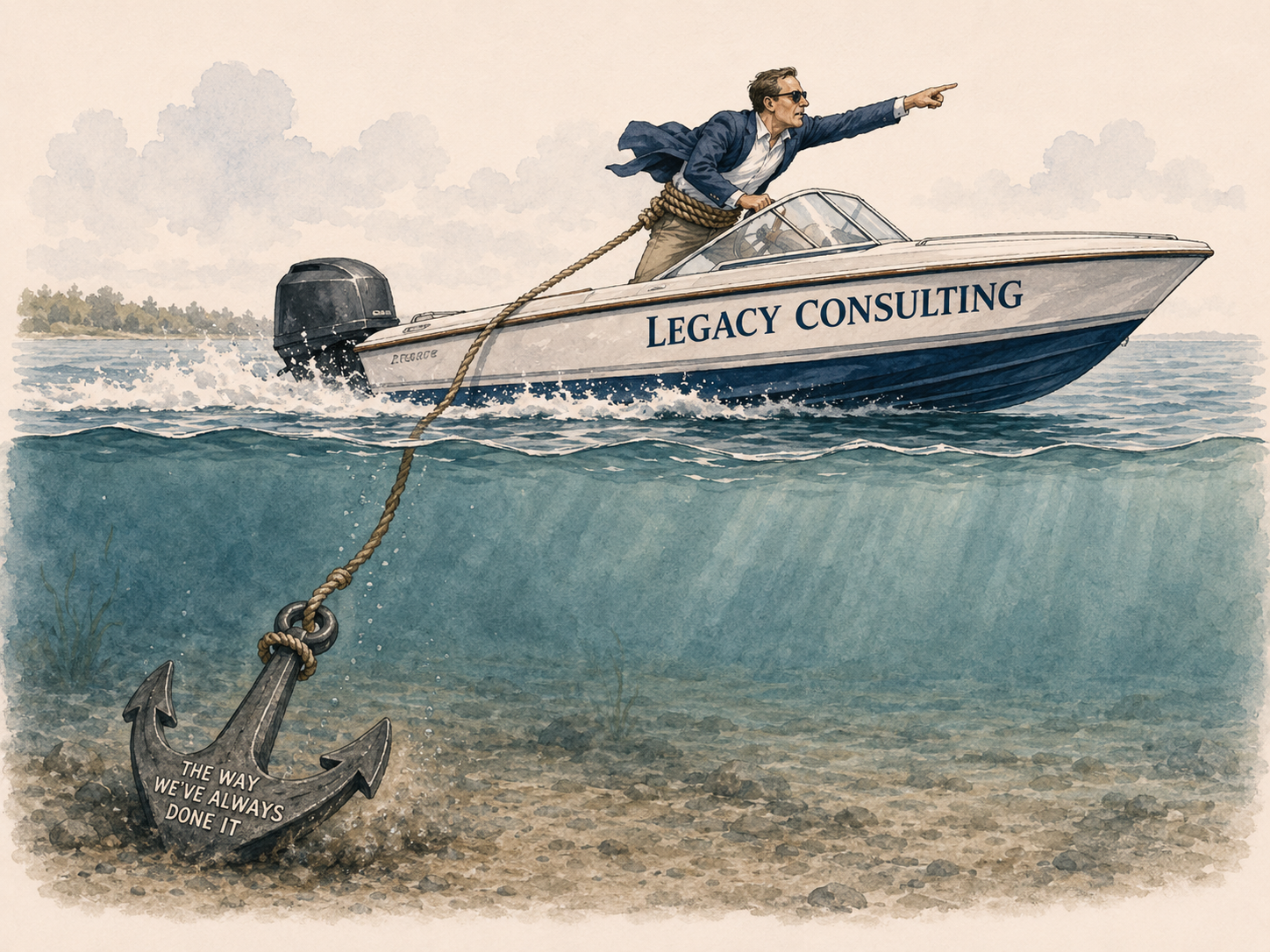
AI is changing the economics of work, the design of organizations, and the pace at which leadership teams must make consequential decisions. Yet much of the legacy consulting model remains built around long studies, fixed teams, junior leverage, and increasingly complicated commercial relationships. Oak Cliff was built for this moment—and for the middle-market leaders expected to navigate it.
Why now
Every company is approaching an operating-model decision.
AI will not simply make individual tasks faster. It will change workflows, roles, decision rights, organizational structures, and ultimately the economics of entire industries.
The immediate returns remain uncertain. The cost of waiting may be even harder to quantify. Leadership teams must decide where to invest, how aggressively to move, and how to bring their organizations through a transition that will be both technical and deeply human.
That work requires more than software deployment. It requires clear strategic choices, operating-model redesign, organizational judgment, and disciplined execution.
Do not fall in love with the technology. Focus on the business outcome and the people change required to caputre it.
Oak Cliff point of view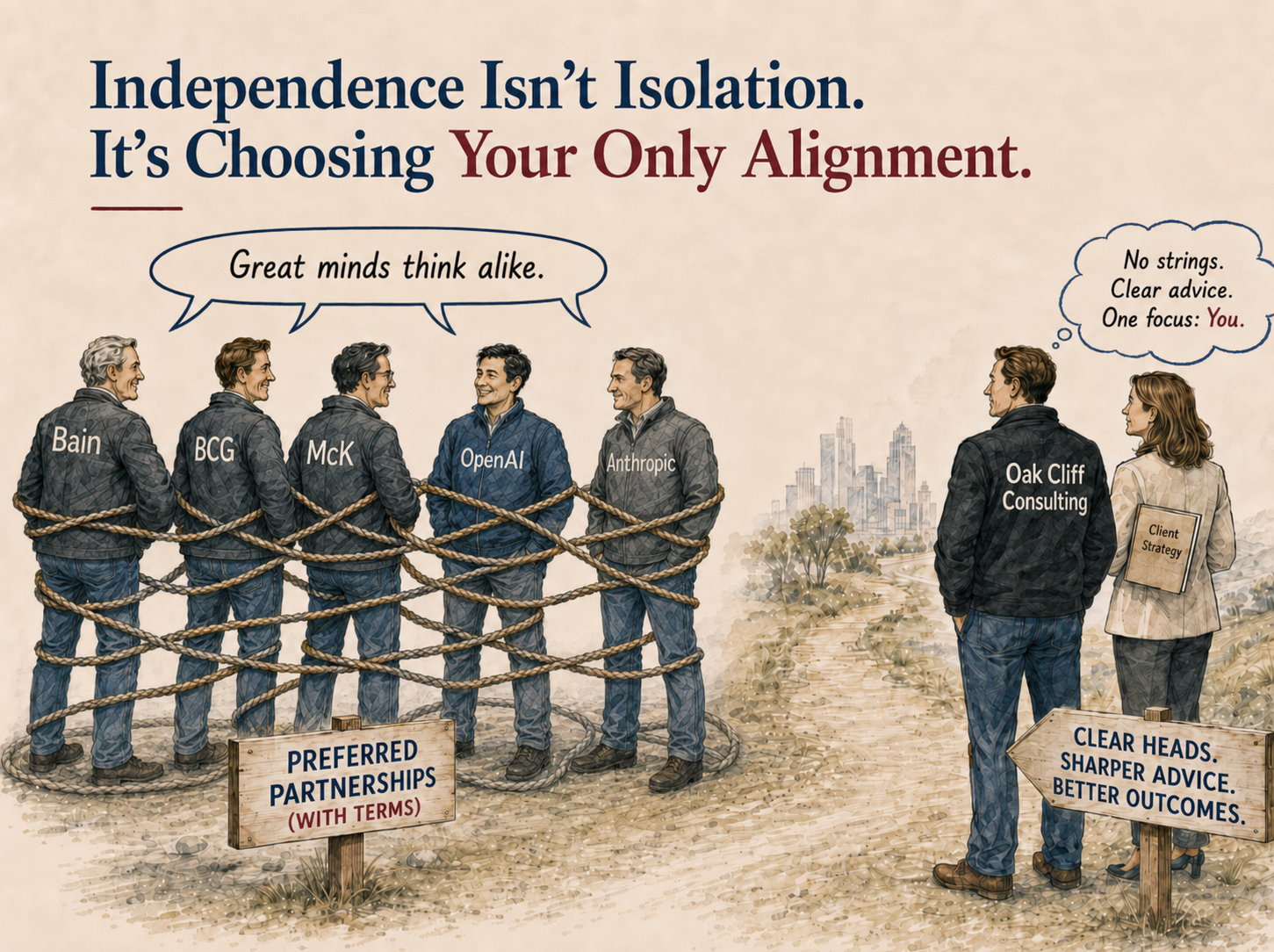
Our belief
Independent advice matters more when the answer is less obvious.
As operators, we believe deeply in the value of outside counsel. At its best, an adviser brings distance from internal politics, challenges comfortable assumptions, and helps leaders see choices more clearly.
But true neutrality has become harder to find. Some of the firms historically known for disinterested strategic counsel now participate financially in the technologies and deployment models they recommend.
That does not automatically make the advice wrong. It does mean leadership teams should understand the incentives behind it—and obtain an independent perspective when the stakes justify one.
Oak Cliff is fully independent. We do not receive compensation from software vendors, model providers, systems integrators, or deployment platforms. Our only economic interest is the outcome our client is trying to achieve.
The middle-market gap
The middle market should not have to choose between the brand and the team.
Large consulting firms can provide extraordinary capabilities. But their delivery model naturally prioritizes their largest relationships. Middle-market clients may pay premium rates without receiving the firm’s most experienced people—or enough continuity to carry the work through execution.
Smaller firms often promise a more senior experience, but the quality of the market is inconsistent. The middle market has been forced to choose between scale without intimacy and intimacy without institutional quality. Oak Cliff was built to eliminate that trade-off.
Large-firm rigor
Structured problem solving, analytical discipline, and the ability to simplify complex strategic issues.
Operator accountability
Advisers who have carried targets, owned outcomes, and lived with what happened after the recommendation.
Middle-market fit
Senior access, flexible support, and a delivery model calibrated to the realities of pace, budget, and team capacity.
Our standard
To advise an operator, you should have been one.
Management consulting teaches people to structure ambiguity, develop insight, and communicate difficult choices. Operating teaches something different: how decisions collide with budgets, personalities, systems, customers, and time.
We believe senior advisers need both. Oak Cliff Partners have worked at top-tier consulting firms and held meaningful operating responsibility—including direct accountability for a P&L, a transformation, a business unit, or an enterprise-level outcome.
They have recommended the answer—and lived with what happened next.
Top-tier consulting training
We value structured thinking, analytical rigor, and the ability to bring clarity to difficult choices.
Meaningful operating responsibility
We value executives who have owned numbers, led teams, faced resistance, and had to make the call when tradeoffs were real.
Senior leadership throughout the work
The people you meet are the people who stay engaged. They are not brought in for the pitch and replaced at kickoff.
Delivery model
The work does not arrive in a pyramid. Neither do we.
Transformations do not require the same people, at the same intensity, for the same number of hours every month. One month may demand concentrated executive alignment and operating-model design. The next may require a data architect, change leader, pricing specialist, or AI engineer. Later, the client may need only a senior adviser to maintain momentum and resolve critical decisions.
Traditional firms solve that variability by staffing a fixed team and keeping it busy. Oak Cliff solves it through a small senior core supported by a curated network of proven specialists who join when their expertise matters—and step away when it does not.
Clients get the capability required by the moment—not the team required by the consulting economics.
Senior core team
A small team of senior operators and advisers leads the work, owns the client relationship, and stays accountable for the outcome.
Curated expert network
Specialists join when the problem calls for them—technical architecture, change management, functional expertise, or AI engineering.
Who we are
Built by people who crossed the table.
We are former strategy consultants who went in-house, ran teams, owned outcomes, and learned what it actually takes to execute. Oak Cliff exists because we could not find the firm we wanted to hire.
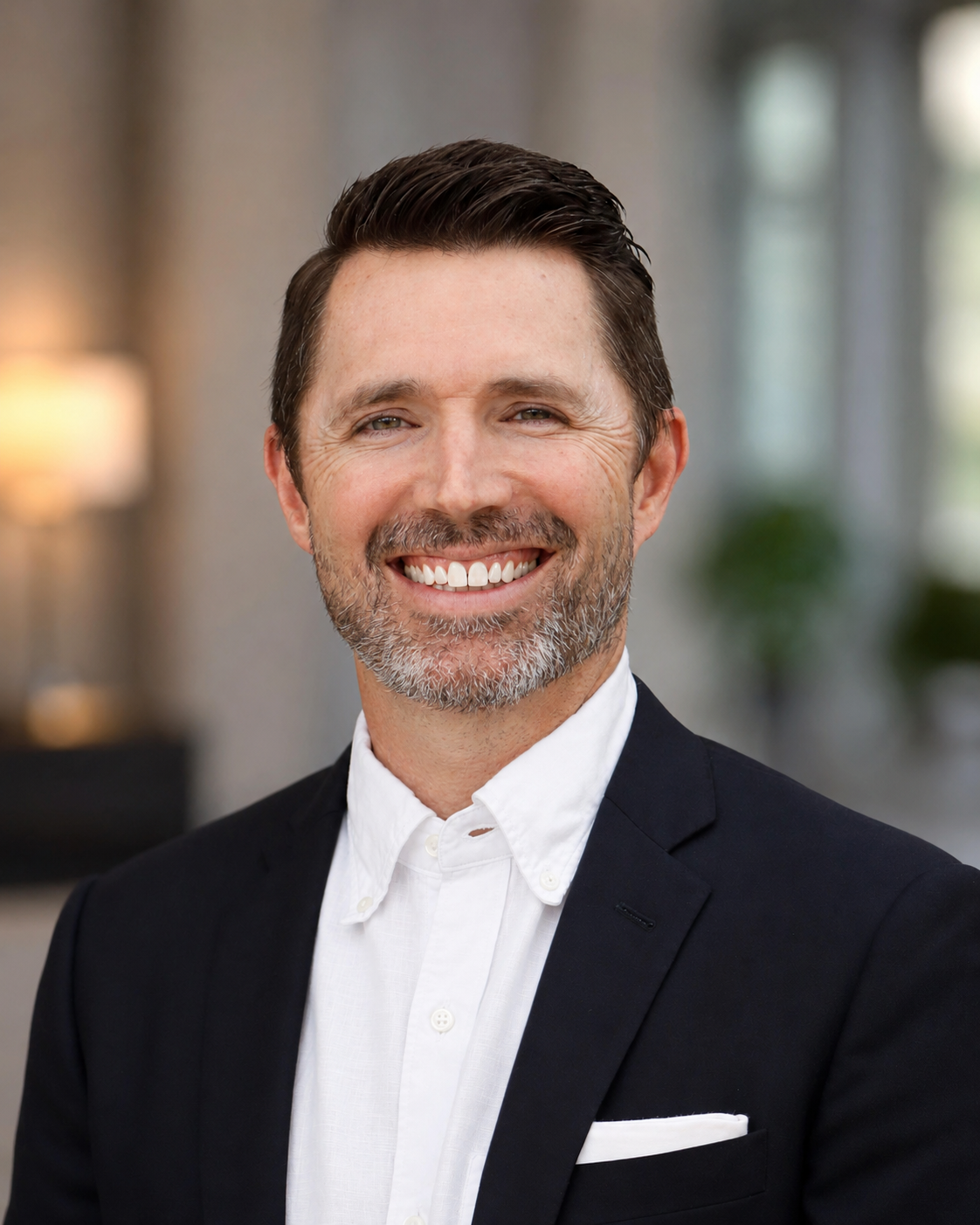
Jerrod Vaughan
Co-Founder & Partner
Former middle-market CEO and former Bain leader. Jerrod has led businesses with direct accountability for growth, organizational performance, and enterprise value.
He works with executives and investors to help organizations sharpen strategic priorities, strengthen execution, and build operating models capable of delivering sustained performance.
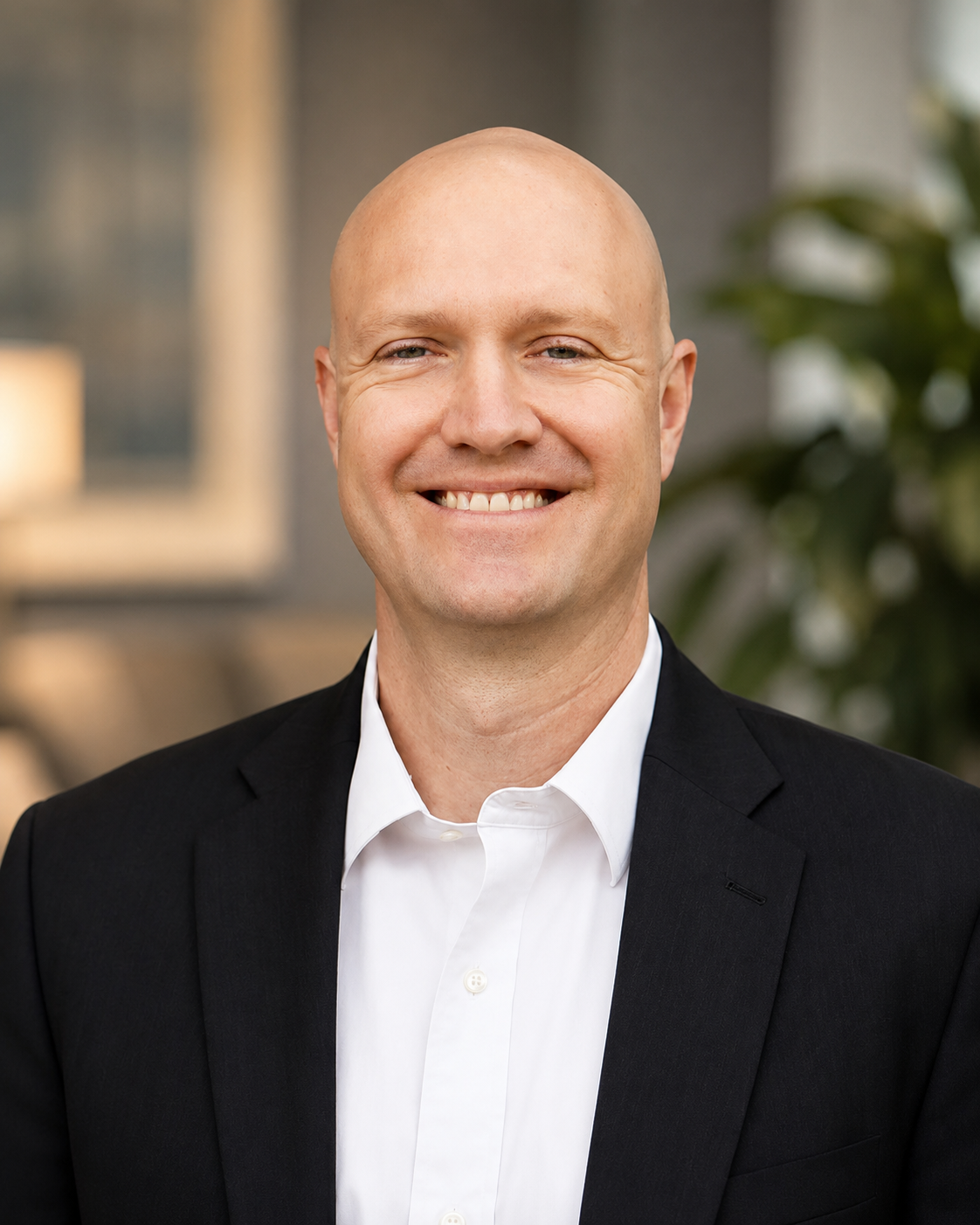
Andrew Meyer
Co-Founder & Partner
Former Chief Growth Officer and Head of Transformation and former Bain leader. Andrew has led operating-model, growth, and transformation efforts from both the adviser’s seat and the executive team.
His work focuses on helping leadership teams make better decisions, translate strategy into action, and lead consequential change with clarity and confidence.
Our closing view
The advice should be independent. The people should be senior. The model should fit the work.
Oak Cliff was built around a simple belief: middle-market leaders should have access to rigorous thinking, experienced operators, and flexible execution support without inheriting the cost structure or conflicts of the legacy model.
The moment demands better questions, faster decisions, and advisers willing to stay close enough to the work to see whether the answer survives.
What Oak Cliff was built to provide
- Independent judgment in a more conflicted advisory environment
- Top-tier consulting rigor with operator accountability
- Senior people who stay engaged through execution
- A flexible delivery model designed around the work ahead
