
AI Transformation Services
AI transformation is an operating model challenge.
Technology creates potential. Redesigning the work, bringing the organization through change, and connecting the effort to the P&L creates value.
Our point of view
Most AI programs start in the wrong place.
Organizations buy licenses, launch pilots, and encourage experimentation before addressing the data, workflows, decision rights, and accountabilities beneath the work.
The result is often more activity, but not a different operating model—and not a measurable financial outcome.
Who we work with
Leadership teams facing a real transformation decision.
We are built for lower- and middle-market organizations that need senior support close to the work—not a large consulting pyramid or a software-led transformation.
Companies ready to move beyond experimentation
CEOs, CFOs, CIOs, and functional leaders who need to connect AI investment to a measurable business outcome and an executable operating model.
Sponsors and portfolio companies with a value-creation imperative
Teams facing a demanding hold-period plan, potential industry repricing, or a need to redesign the cost base and strategic moat.
Organizations already navigating consequential change
New leadership teams, integrations, operating-model resets, and businesses where AI can accelerate a transformation that already needs to happen.
The questions we help answer
What executive teams need to decide before they transform
The technology will continue to change. These operating questions will remain.
01 Why are so few AI investments producing measurable value?
Because most organizations begin with the tool rather than the business outcome.
AI gets layered onto fragmented data, inconsistent processes, unclear decision rights, and roles that were never redesigned for the new way of working. The organization may become more fluent in AI without becoming materially more productive.
Tool adoption is not transformation. Value appears when the underlying work changes and the impact can be seen in cost, growth, cycle time, working capital, or customer experience.
02 Is AI transformation really a technology transformation?
Not primarily. It is an operating model transformation enabled by technology.
Engineering matters. But the harder questions concern how work gets completed: which activities should disappear, which roles should change, where humans should remain in the process, who owns decisions and exceptions, and how the organization will measure value.
The technology can move quickly. The organization rarely does. That gap is where most value gets lost.
03 What does a successful AI transformation require?
Our experience points to four beliefs that separate the rare successes from the efforts that stall.
A clear North Star
The organization needs a simple, shared view of where it is going and what measurable value success creates.
Visible executive ownership
Leaders must personally define, repeat, and defend the case for change—not delegate it to a project team.
Middle-management-out change
Middle managers translate strategy into daily behavior. They should lead the redesign, not receive it after the fact.
Reversible decisions
Most choices should be treated as two-way doors: act, learn, adjust, and preserve escalation for the few irreversible calls.
04 What is the difference between augmentation, automation, and autonomous execution?
These are different levels of operating-model change—not interchangeable labels.
Augmentation
AI helps a person perform the work. The role and workflow remain largely intact.
Automation
AI completes part of an existing workflow and flags outputs or exceptions for human review.
Autonomous Execution
AI runs an end-to-end process, with clear human checkpoints, exception rules, and accountability.
For most incumbents, autonomous execution is the destination. Augmentation and automation are useful waypoints, but they rarely represent the full economic opportunity.
05 Who should lead the transformation?
The CEO should own the vision. A dedicated AI Transformation Lead should own execution.
That leader should spike in operating-model redesign, change management, cross-functional execution, and executive communication—not simply engineering. The role requires enough technical fluency to guide the build without falling in love with the tool.
06 Should we begin with technology or organizational redesign?
Begin both the data foundation and transformation design immediately.
Do not wait for perfect data before redesigning the work. But do not build isolated agents on top of fragmented information, unclear processes, and decision rights that no one has resolved. The data and operating-model work should move in parallel.
07 How do we know whether we are ready?
You should be able to describe the financial outcome you want, identify the workflows with the largest value potential, access enough trusted data to establish a baseline, and name an executive owner plus middle managers capable of carrying the change.
You do not need perfect data or a complete future-state design. You do need enough clarity to know what business problem you are solving and who is accountable for moving it forward.
The transformation roadmap
Where should an organization begin?
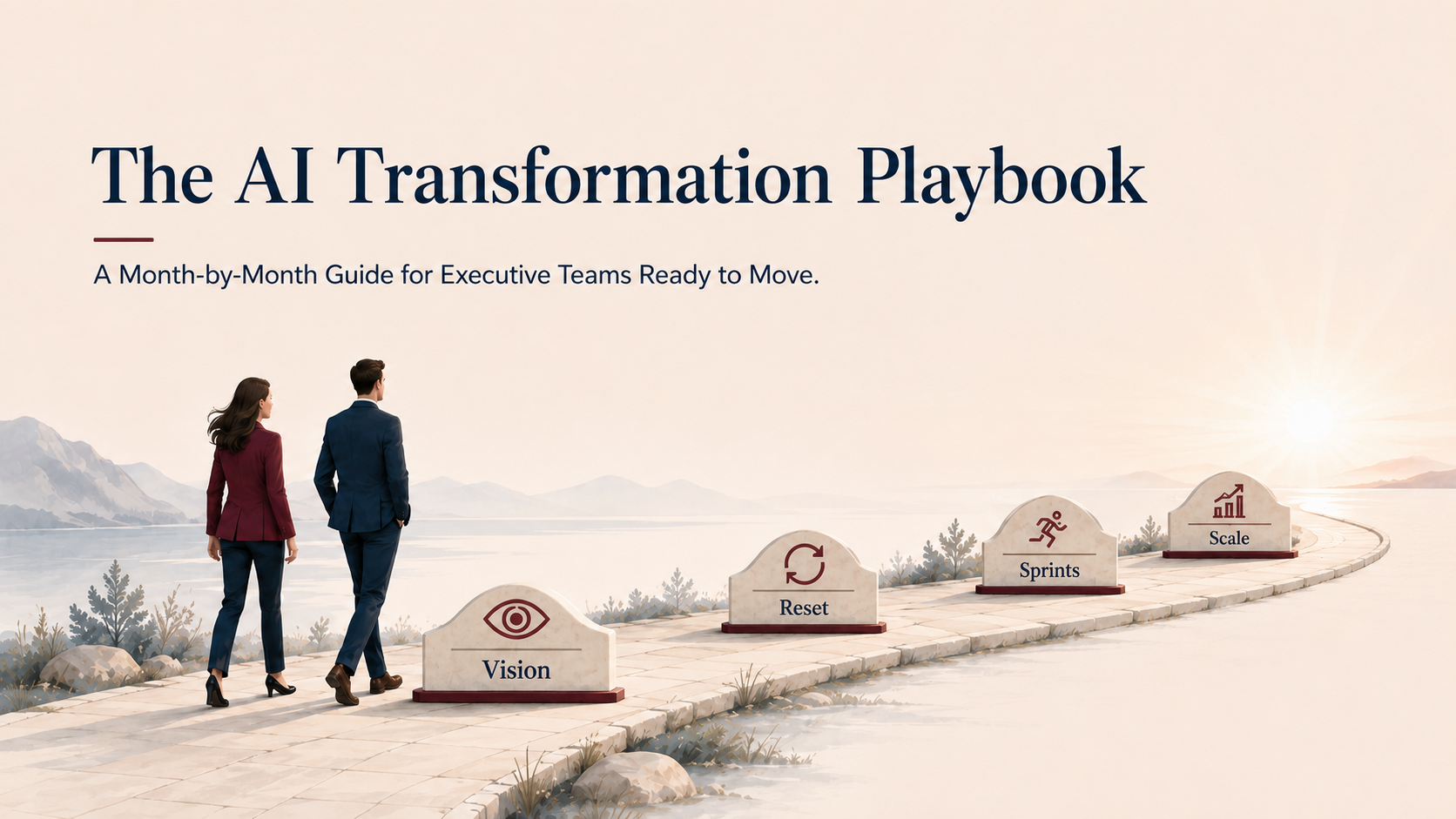
Start the data foundation and transformation design at the same time. Do not wait for perfect data before redesigning the work, but do not build isolated agents on top of fragmented information and unclear workflows.
Foundation
Set the full-potential ambition, establish the data foundation, and diagnose roles, workflows, governance, and accountabilities.
Reset
Redesign the operating model: organization, job accountabilities, critical processes, decision rights, and meeting cadence.
Sprints
Begin with contained back-office processes that have measurable baselines and limited downside if the solution fails.
Scale
Move into customer-facing processes, broader autonomous execution, and sustained value tracking.
What Oak Cliff provides
A Fractional AI Transformation Office
A senior transformation leader works alongside the executive team, supported by operating-model expertise, program-management capacity, change leadership, and embedded AI engineering.
Executive alignment
Define the full-potential ambition, financial case, transformation thesis, and leadership narrative.
Operating-model redesign
Redesign roles, workflows, decision rights, governance, accountabilities, and organizational interfaces.
Transformation leadership
Provide a dedicated leader accountable for translating the ambition into a sequenced roadmap and sprint backlog.
Program management
Run the cadence, track Red/Yellow/Green progress, surface risks, and maintain executive accountability.
Change management
Equip leaders and middle managers to communicate the case, lead redesign, and carry the organization through uncertainty.
Embedded engineering
Add the technical capacity needed to connect systems, manage permissions, build tools, and move from prototype to production.
Why Oak Cliff
People who understand both the executive decision and the operating reality.
AI transformation cannot be led effectively from a software demo or a strategy deck alone. It requires people who have owned the P&L, led organizations through uncertainty, and stayed close enough to the work to understand where execution actually breaks.
Further reading
Our AI Transformation Series
Not sure where your organization should begin?
Bring us the business outcome, the stalled pilot, or the operating-model question. We will give you a direct answer.
